Solar-powered planes fly over Alps bring question mark for 'Fossil Flight' future
Solar Stratos aircraft are even capable of flying parallel to fossil-fueled commercial jet aircraft.
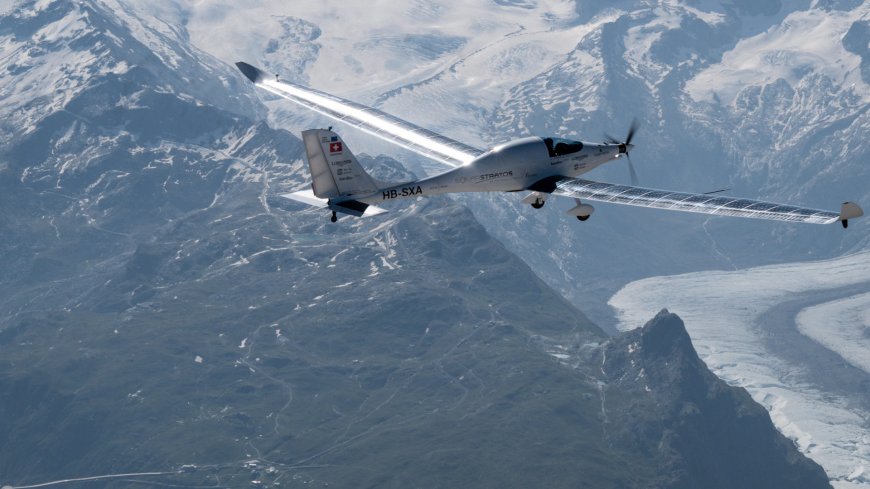
MOSAIC-INDONESIA.COM; The year of 2025 bring amazing innovations in renewable clean energy. For the first time, a solar-powered plane SolarStratos managed to soar above an altitude of 31,000 feet. The flight, which managed to cover 8,224 miles, even shook up the aviation industry. Are avtur-fueled aircraft still relevant to use in the future?
SolarStratos darted into the stratosphere to break records. Piloted by Raphaël Domjan, a Swiss environmental explorer, the solar-powered plane successfully flew without fuel. In addition to breaking records, this flight mission also managed to demonstrate that the aviation world no longer needs to depend on fossil fuels.
Raphaël Domjan took a plane with a total wing of 24 meters to fly over the Swiss Alps. The mission, completed from Sion Airport in southwestern Switzerland, surpassed the record certified 15 years ago of flying above an altitude of 30,298 feet.
Domjan's sleek white plane, built by clean energy company SolarStratos, harnesses warm thermals and pure sunlight to thin air, so high. Domjan even found himself sharing air space with commercial jetliners.
“This achievement is considered one of the most unforgettable peaks that define great human and technological adventures,” SolarStratos said in a statement on December 12, 2025, as reported by Weather.com.
For Domjan, a true advocate of solar energy innovation, the momentum is more than a record. “I really fell in love with this energy,” she says gleefully. “Anywhere on the planet you can find the sun. So for me, this is really the future of mankind.”
Nevertheless, Domjan said, many people still underestimate the power of modern solar technology. “Other people think it's expensive and they think there's not enough power,” he said. “This is not true at the moment, this is probably the cheapest energy ever,” he explains.
His record-breaking efforts depend on one major factor: managing that energy intelligently. “You need to maintain energy, you need to fly at a good speed, with good power, to always be in optimal condition,” he explains.
Without fuel on the plane, every watt means a lot. The plane's batteries must be charged for a day and a half in the sun before takeoff. As Domjan landed nearly five hours later, his battery showed about 20%, enough for safety, but close enough to underscore how tight the margin there was.
Domjan said he was interested in solar power because it produces enormous, clean, limitlessly available energy that he thinks is “the future of mankind.”
Check out this post on Instagram
Far above the Alps, Domjan found himself aligned with a commercial jetliner. “I fly on a passenger plane! At the same altitude, I could see it was a Lufthansa flight, an Airbus A320,” he recalled. “They think, it's impossible!”
Domjan was able to witness the vast expanse of the earth. “From where I am, I'm right over the Matterhorn and I can see the Mediterranean Sea,” he said, while mentioning the sunny and beautiful weather he experienced during the flight. 'It was absolutely amazing. I can see very far away.”
A few days earlier, winds at 30,000 feet were blowing at nearly 80 knots, twice the speed of Domjan's own air. “I'll probably drift off to Italy,” he grumbled.
SolarStratos was one of the first manned flights to use 100% renewable energy. Without the use of fossil fuels that have long dominated the aircraft industry, these flights would produce no emissions. The project has shown the world how clean solar energy can produce planes flying into the top layers of Earth's atmosphere.