Solar energy in Gaza: A lifeline in ruins and a vision for renewal
Gazans innovated with various methods of electricity generation and distribution. These informal systems supplied the remaining 25% of Gaza’s electricity.

MOSAIC-INDONESIA.COM — For over two years, the people in Gaza have lived without reliable electricity. The Israeli occupation has cut off access to energy, crippling not only homes, clean water systems, and production facilities like bakeries, but also critical medical infrastructure such as clinics and hospitals.
Before the genocide happened, Gaza had relied partly on solar energy infrastructure built by international agencies and local activists. A report published by CSIS even suggested that Gaza may have had the highest density of rooftop solar panels in the world. Solar power offered a more reliable energy source for Gaza because it was not subject to the politicization of fuel and energy exports from Israel.
Israel’s genocide has taken a heavy toll. Under the pretext that electricity could be diverted from civilian to military use, Israel has destroyed much of Gaza’s rapidly growing solar infrastructure during the ongoing war. Nevertheless, solar energy had once been a lifeline for Gazans when all other power sources failed. Gaza’s experience highlights both the potential and the limitations of solar energy in conflict-affected environments.
Solar energy sustained Gaza before the War
Even before the genocide, periodic Israeli attacks frequently damaged Gaza’s electricity infrastructure. Under “normal” conditions, demand far exceeded supply, with millions of Gazans reportedly receiving only 6 to 8 hours of grid electricity per day.
Due to chronic shortages, Gazans innovated with various methods of electricity generation and distribution. These informal systems supplied the remaining 25% of Gaza’s electricity. According to CSIS, a recent internal survey by an international humanitarian organization identified 23 different technical arrangements for electrical systems operating off-grid (either fully off-grid or hybrid).
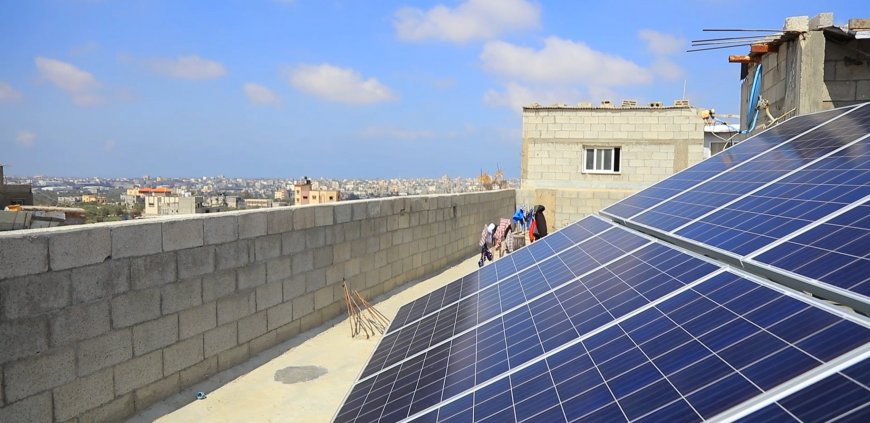
These included small generators and solar systems. With 320 sunny days a year and many flat-roofed buildings, Gaza was ideally suited for rooftop solar panels. Despite periodic Israeli restrictions on solar panel imports, their use grew dramatically.
Rapid growth
Households that could afford solar panels quickly adopted them. The number of solar installations in Gaza grew exponentially—from just 12 in 2012 to 8,760 in 2019, according to a 2021 study. CSIS analysis of satellite imagery from May 2022 found at least 655 rooftop solar systems in a one-square-mile sample area of Gaza City—likely representing the highest rooftop solar density in the world.
It is difficult to estimate the total number of rooftop systems in Gaza before the war, but initial analysis suggests there were over 12,400. Land-use classification by He Yin of Kent State University shows that in 2023, Gaza’s total area was 140 square miles, with 38 square miles developed. Even if the sample area had twice the average density, CSIS estimated the total would reach around 12,445 systems.
An electrical engineer from a Gaza solar business confirmed the high adoption rate, estimating that by March 2023, at least one-third of Gaza and over 50% of businesses used solar panels.
International Investment in Humanitarian Solar Projects
International donors have also funded solar energy for critical humanitarian infrastructure, including hospitals and water systems.
- A World Bank project worth $11 million, launched in 2018, provided loans to households and businesses, and grants to vital public services like hospitals, for solar panel installation.
- A UN program worth $2 million installed solar power systems in four Gaza hospitals.
- Germany provided $92 million for the Central Bureij Wastewater Treatment Plant, which achieves energy independence through a 4 MW hybrid solar and biogas plant.
- The International Finance Corporation structured a debt financing package for solar installations in Gaza’s industrial zone.
While the environmental benefits were clear, donors also saw distributed solar systems as a way to enhance energy resilience, reduce dependence on fuel imports, and allow quicker repairs compared to large power plants.
Lihat postingan ini di Instagram
The Impact of Israel’s War on Solar Infrastructure
Israel’s genocide has crippled Gaza’s electricity network. UN agencies reported their fuel supplies ran out about a month after October 7, forcing hospitals and desalination plants to shut down. By November 17, internet and phone services in Gaza collapsed due to fuel shortages, halting UN aid deliveries.
The blockade on fuel imports also prevented many private diesel generators from operating. Only those with their own fuel reserves could continue.
The fighting has also destroyed solar systems on critical infrastructure. Satellite imagery shows evidence of Israeli attacks damaging larger-scale solar installations, including the German-funded Gaza wastewater treatment plant, which had only opened in April 2023.
Al Jazeera reported that Israeli strikes destroyed rooftop solar panels at Gaza City’s al-Shifa Hospital on November 6. Smaller rooftop systems have also been devastated. Satellite imagery from a one-square-mile area of Gaza City taken on November 11, 2023, shows that 17 out of 29 large rooftop solar systems (100 m² or larger) were either completely destroyed or showed external damage. Rooftop systems are particularly vulnerable to battle damage due to their exposed, elevated mounting.
Energy in Post-War Reconstruction Plans
Energy is a key issue in discussions about Gaza’s reconstruction once the current “fragile” ceasefire holds. In the long term, many countries are already competing to advance their own reconstruction visions.
Egypt, along with 21 other Arab League members, has proposed a plan to counter Trump’s “Riviera” concept. Their plan includes building a 2,500-megawatt power plant—about 20 times Gaza’s pre-war capacity—incorporating solar, wind, and fossil fuels, as reported by Grist.org.
They are not alone in envisioning Gaza as a renewable energy hub. The Palestinian Authority, hoping to replace Hamas as Gaza’s governing body, is developing a priority infrastructure master plan with the World Bank, EU, UN, and Arab states. Wael Zakout, the PA Minister of Planning and International Cooperation, said solar and wind power across Gaza could make it “the first region in the world to achieve Net Zero Emissions.”
Another idea, discussed and supported by Trump during his first term, is to build a solar farm in Egypt’s sun-drenched Sinai Desert, just across Gaza’s southern border. Supporters say this would free up land in Gaza for other uses and, being located in Egypt, would be less likely to be targeted by Israel.
Beyond Renewables: The Natural Gas Question
Renewable energy will not be the only resource considered for Gaza’s recovery. A medium-sized natural gas field was discovered off Gaza’s coast in 2000. Political and economic conditions have hindered its development, but the US, Egypt, and Israel have described it as an untapped energy reserve for Gaza.
In November 2023, Amos Hochstein, President Joe Biden’s Middle East envoy and a former energy executive, said, “as soon as we reach the day after and this terrible war ends, there will be companies ready to develop these fields.”
Proponents argue gas-fired electricity would strengthen Gaza’s overall energy supply and enable large-scale industrial infrastructure, such as desalination and wastewater treatment plants, improving daily life.
A Decentralized Future?
Josef Abramowitz, an Israeli-American solar developer who has previously worked with Palestinian partners, argues that an emphasis on large-scale projects overlooks the decentralized model that has proven most successful in Gaza. “The story of Gaza is: big projects that don’t happen,” he said.
Abramowitz favors a minigrid model: localized networks of solar panels and battery storage. He believes these facilities could supply 24-hour power at a far lower cost than gas-fired plants. They are flexible, sustainable, and—crucially in a context marked by blockade, frequent warfare, and poor governance—viable with or without a grand resolution to the Israeli–Palestinian conflict.