A new energy era begins: Renewables outshine coal in global power generation
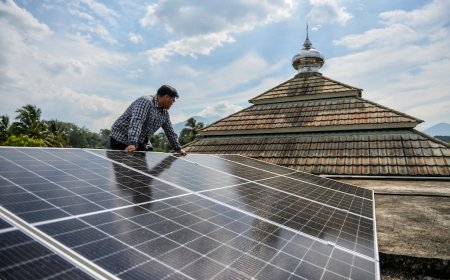
A major driver behind the rise in clean energy adoption is the steep drop in solar costs.
MOSAIC-INDONESIA.COM, JAKARTA — Beyond marking the milestone of a solar-powered aircraft soaring above 31,000 feet, 2025 carved a new chapter in global clean energy achievements. A global energy think tank, Ember, reported that for the first time ever, green energy has surpassed fossil fuels like coal.
Zmescience reported, zero-emission energy sources — dominated by solar and wind power — have generated more electricity worldwide than coal.“Overall — we’re speaking globally — renewables have overtaken coal,” said Malgorzata Wiatros-Motyka, senior electricity analyst at Ember, in an interview with Grist. “And I expect this to last.”
This achievement marks a historic turning point decades in the making. Renewable energy sources supplied 34.3% of the world’s electricity between January and June 2025, while coal dropped to 33.1%, according to Ember’s findings. For a global energy system that has relied on fossil fuels since the Industrial Revolution, this milestone is nothing short of revolutionary.
Tipping point
Ember described this achievement as a “critical tipping point.” The growth of solar and wind energy not only met the rise in global electricity demand — it exceeded it. This has also led to a slight decline in fossil fuel use for the first time.
Solar power carried most of the load, supplying 83% of the rise in electricity demand, and has now been the world’s largest new source of electricity for three consecutive years.
“This moment marks the beginning of a shift where clean energy can keep pace with demand growth,” Wiatros-Motyka told the BBC.
Clean energy surge
A major driver behind the rise in clean energy adoption is the steep drop in solar costs. Since 1975, the cost of solar energy has fallen by 99.9%. Many of the fastest adopters are in the Global South, with nearly 58% of global solar capacity now coming from low-income countries.
Pakistan imported solar panels in 2024 to generate 17 gigawatts of solar power — double the previous year and roughly one-third of the country’s total electricity capacity. Across Africa, solar energy imports rose by 60%, led by South Africa, Nigeria, and Algeria.
In China, clean energy growth has been so rapid it seems almost unreal. The country added more solar and wind capacity than the rest of the world combined, according to Ember. China even managed to reduce fossil fuel power generation by 2% and contributed 55% of global solar growth.
Independence and investment
This transformation brings benefits beyond emissions reduction. Shifting toward renewables gives countries greater energy independence from imported fuels.
“There is more investment in infrastructure that facilitates clean growth [in developing countries] than in many developed countries,” Wiatros-Motyka told NPR. “It may be that some countries are missing opportunities, and perhaps they don’t realize it, but that is the reality,” she added.
Developed nations lag behind
The rapid progress in renewable energy in developing nations stands in stark contrast to trends in developed countries.
In the United States, coal-fired power generation increased by 17% in early 2025. Meanwhile, the International Energy Agency (IEA) has halved its U.S. renewable growth forecast for this decade, from 500 gigawatts to 250 gigawatts.
In July 2025, Congress voted to phase out long-standing tax credits for wind and solar energy. The Donald Trump administration has also sought to halt or delay dozens of renewable energy projects. Despite the administration’s almost visceral disdain for wind turbines and solar panels, it cannot stop the inevitable.
“They can slow it down; they can do far more damage than I thought,” said Robert Brecha, senior advisor at Climate Analytics. “But they cannot stop it.”
In Europe, unfavorable weather — not politics — has dimmed clean energy prospects. Months of low wind speeds and drought reduced renewable energy output across the continent, leading to a 14% increase in gas-fired electricity generation.
Nevertheless, the global narrative is clear: coal’s dominance is ending. The IEA still lists coal as the single largest energy source, but its market share is shrinking rapidly.

China’s dominance
China is the epicenter of renewable energy growth, producing the majority of the world’s solar panels — accounting for roughly 80% of global production. In the first half of 2023 alone, China’s solar module exports reached 114 GW, a 34% increase from the previous year.
As Daniel Cohan, a civil and environmental engineer at Rice University, told NPR:
“China took technology originally developed in the United States at Bell Labs in the 1950s and figured out how to scale it.”
The result is a clean-tech manufacturing empire that extends beyond solar energy to other verticals. In August 2025 alone, China’s clean-tech exports hit a record US$20 billion, driven by soaring sales of electric vehicles and batteries.
US faces new energy demand challenges
Meanwhile, the U.S. faces a new kind of challenge scarcely anticipated a decade ago: energy-hungry data demand.
“This is really a turning point for the United States,” Cohan said. “With data center growth, AI and crypto, and other industrial and air conditioning growth, we’re starting to see electricity demand growing 3% per year, rather than stagnating or growing 1%.”